Post: 7 basic advice πŸ™ for gut health πŸ€—

Researches show Gut health accounts to almost 70% of the body’s immunity. It’s an ecosystem of about 40 trillion microorganisms, living inside your body plays a vital role in almost every biological functions in your body. Therefore, it goes to show, how important a role, gut health plays every day to keep you healthy and strong from any kinds of diseases and sickness.

Too many information, too many dietary advice floating on the internet, not only makes you confuse but sometimes even give wrong information or just misleading information.
7 basic science backed recommendations for gut health :
1.There is no such thing called “The healthy diet”. If one diet works for one person may not work for another person. Therefore, the only basic dietary advice can be you should eat enough of plant-based food. You should feed yourself with varieties of veggies and fruits, preferably fresh and locally available. Probiotic foods are also gut friendly. Remember, you have a huge colony of microbes in your gut. If some may prefer some kind of food, other microbes may like some other kind of food. This way, you can make them happy and they work together for your stronger health.

Sugar foods

2.Big “NO” to sugar: Just say, “NO” to sugar and all artificial sweeteners. The natural sweetness in fruits and veggies and also natural sweeteners like honey, maple syrup is not that harmful. Otherwise, sugar alters the composition and functions of natural gut microbes and becomes the feast for harmful bacteria and fungus-like Candida.

3. Say “NO” to processed food and food with preservatives. Harmful preservatives (Like polysorbate 80, carboxymethylcellulose ) alter the composition of gut microbes. Genetically Modified food (bioengineered food) are also very harmful to gut health because they use some kind of pesticides while growing them. Common GMO food is corn, soy, some veggies like zucchini, squash. So, organic, or naturally grown veggies and fruits are best.

3. Avoid popping up pills: Say no to antibiotics and NSAIDs (aspirin, Advil ) as far as possible. Both these drugs alter the composition and function of the gut microbiome. Use it only when necessary.

4.Please quit smoking: Studies have shown that smoking causes alteration in the composition of the gut microbiome. Therefore, another reason added to the list to quit smoking.

5 Get out in Nature: People living the sedentary city lives, hardly come across varieties of microbiomes. So, the only way to expose yourself to varieties of microbes, a wider ecosystem is going out in nature, spending as much time, going hiking, biking and lot more of physical activities.

6.Have a pet at home, that also helps to increase your microbiome diversity.

7. Routine advice: Get plenty of quality sleep of 7-8 hours, exercise and eat in scheduled time preferably. All of them contribute to your gut health.

Thanks for reading.

Much love to all πŸ’

Post : Are genes linked to stress ? 4 points of clarifications.

Some 50 – 80 years ago, people rarely used the word “stress”. Maybe the word was just another word in the dictionary whose meaning had the least relevance in their lives. But, today, it is the most common widely used word in every individual’s life.

Today, everywhere, you go, stress can follow you. At home, at the office, stuck in traffic, getting late and the list goes on. Therefore, the most common causes of stress in people’s lives nowadays.

Relationship stress.
Financial stress.
Workplace stress.
Health concerns.
Daily chorus stress.

4 points of clarifications as to how genes are linked to stress.

1.Genetical predisposition: Often seen, some people tend to battle more with day to day stress than some other people. So, how are genes related to our body’s psychological response? Genes produce proteins which influences our body’s reactions to different psychological responses and, stress being one of them. Single nucleotide polymorphism (SNP), are tiny differences in the genes which affect the release of hormones and proteins in the body and determine the psychological responses. This is a reason, different people react differently and have a different level of stress for the same particular situation.

2.COMT gene: Catechol – Omethyltransferase is an enzyme which causes the body to break the stress hormones like epinephrine, norepinephrine and dopamine. Epinephrine and epinephrine are hormones produces during extreme stress, under fight and flight response whereas dopamine is feel good (reward) hormone which also function as a neurotransmitter. So depending on which version of the COMT gene you have, your genotype can be a :

Warrior gene: Those who perform well under stress or under pressure.

Strategic gene: Those whose performance suffers during stress but performs well in calm situations.
Combination of both: Those who are quite in between.

3.BDNF ( brain-derived neurotrophic factor): BDNF normally function as protecting and creating new neurons, strengthening the signals between neurons. As far as stress is concerned, this protein acts as a resilience factor. This helps you to tolerate and resist the stressful situation and can still act and make you perform without affecting your health and wellbeing.

4.Managing stress level: This is the most important part of this topic. So how do we manage stress level? Depending upon, genetic predisposition, you may be the either high or low level of stress resilience. So, easy steps to handle routine stress are:
Breathing/relaxation: Deep breathing is a simple step that can be effective to control stress. Because, when you breathe deep, this makes the brain to relax and calm down.
Exercise: When you exercise, your body releases endorphins, your body enters the feel-good phase. 2 types of endorphins: Anandamide and serotonin.

Exercise increases your level of anandamide which helps the body to produce BDNF which in turn helps to regulate stress.
Serotonin is a feel-good chemical which makes you happy, motivated which can be boosted by exercise, walking, running or any physical activity which you enjoy doing. When serotonin is level is maintained, stress is less likely to occur.

Post: Sitting, a health hazard !

Sitting, a health hazard !

Sitting long is as hazardous as smoking. When we sit long, we use less energy and body’s metabolism slows down. This in turn give rise to a host of health concerns.

Right from evolution, the human race was never meant for a sedentary lifestyle. Humans had to work hard, struggle a lot to survive on earth. But things dramatically changed with science and technology. With each passing days, as our comfort level rises, the human behaviour and habits changed. It was more of mental work and less of physical activity. But our body’s physiology remained the same. We, humans were never meant to sit or lie down long. We were meant to stay upright. Staying upright actually helps our body’s metabolism and digestion to function appropriately. Body’s energy store is well utilised and bone strength is maintained. 

Talking about health hazards, sitting long slower the metabolism and as a result body’s over all energy utilisation is reduced. The muscles of the legs, back, abdomen loosen and relaxed. With such posture for a long time can lead to chronic body, back, leg pain. Since, the metabolism decreases, there is chances of high blood sugar, high cholesterol, increase fat store in the body. The chances of obesity, fatty liver, diabetes are all on rise. There is high risk of cardiovascular diseases and cancer contributed to mortality rate. Recent studies have found that sitting prolong for than eight hours can have the same risk of dying similar to the risk of dying from smoking and obesity.

Different researches are going on throughout the world on various recommendations of how long sitting hours and how many hours of physical activity required for different age group of people. So the exact hours and time is quite difficult to recommend. But the simple rule I follow, is trying to build a habit, an awareness, a reminder to move around, have a bit of physical activity in between interval of at least 30 mins of sitting continuously. Apart from that, there is my routine daily physical activity or exercises of at least 60 mins. Different people have different level of endurance and bodily requirements. So it is wise to choose your own convenient routine of physical activity and bodily movements. My intention of writing this post was to make you aware about the dangers of sitting long. If you feel that you are not doing enough of physical activity, it’s never too late to turn around and increase your movements. So in the process, you will enjoy the great health benefits from this simple change of habit. 

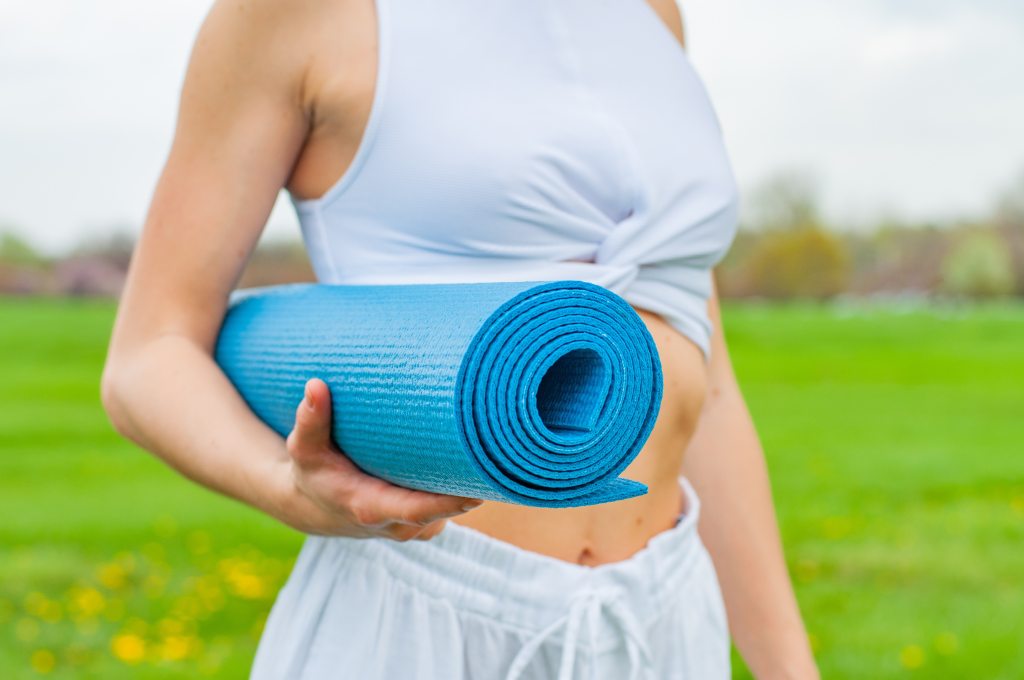
My take on yoga mat….

Practising yoga is my daily routine regime for health and wellness. But do I have made the right choice of yoga mat where I enjoy doing my routine practise ? Or is it worse like sliding and slipping very often while holding a posture ?

Before, jumping onto the topic of yoga mat availability and preferences, I would like to share some insight facts about Yoga.

It’s an ancient Indian practice of mind, body and spirit connection. Traditionally, it was practised by the yogis to keep them in discipline with their mind, body and spirit. The ultimate goal of all traditional forms of Yoga was to attain samadhi (enlightenment). All the traditional forms of Yoga like Hatha Yoga, Bhakti yoga, Jnana yoga and Karma Yoga has the same common goal to help reach the samadhi state. Though it is not associated with any religion, it is more of a spiritual practice than a fitness method. Therefore, while practising Yoga, the spiritual essence is very important. Today, because of its popularity in the entire world, the deviation from the actual traditional Yoga has been a concern. It has become more of a fitness tool to build up muscles, stretching, flexing muscles and aerobic exercises. The popularity has been boosted due to its immense benefit on many medical ailments like mental illness, schizophrenia, anxiety, stress and bodily pain. In fact, studies have found that practising yoga and meditation regularly can be beneficial and facilitate healing of all type of physical and mental illnesses. 

I, myself have been a yoga practitioner for the last 5 years. It has not only helped me become more self – discipline and focused but also benefited me both physically and mentally. That is how , I have started to know about Yoga Mat.

As a routine practitioner of Yoga, I know how it is important and essential to have the right kind of yoga mat. Whenever, I use to step into a store, to buy my yoga mat, seeing the different types of sizes and colour, I always ended up in a confusion. Sometimes, picking up the wrong mat, make me realise it to be too thick, slippery, sticky and easily damaged. This has happened to me a number of times. In the course of my experience, I have started to learn the right kind of choice of Yoga mat which does work for me and also last longer without damage. 

Yoga which has gained immense popularity in the fitness industry, likewise the yoga mat companies have become billion dollar industries. When we step inside a store, there are a lot of different types of yoga mats with different materials, sizes and colour. Keeping up the popularity, comfort and trends, different materials of Yoga mat has been in the market, starting from rubber, plastic, cotton, jute and also PVC, latex. Depending upon our essentially, comfort and durability, the choice should be made. Since it’s for our daily routine use, toxic material like PVC, latex should be avoided. As for new beginners of Yoga, the mat should be of sticky material like natural rubber.

Though not a beginner anymore, my personal preference has been always a natural rubber mat. Such a mat would help better grip and prevent from slipping while holding asanas (Yoga poses). Eco-friendly material like cotton and jute mats have become very popular for health reasons and in a warm climate. They are comfortable and help in absorbing sweat. But the wear and tear are more due to the material. Plastic elastomer is the new material that has been widely used in Yoga mats. These mats are quite cheap and health friendly too. One more important aspect of the Yoga mat is the thickness. Regarding the thickness of the mat, it may vary from a range of 1/16 to 1/4th  of thickness. Again, this is a personal choice depending on what type of floor, we do routine practice and the kind of cushioning required. Usually, the i/8th thickness is most preferred for its durability and performance. Nowadays, yoga mats are available with a travel bag, that helps us to carry along wherever we travel. But, yes, many buy it to look cool and trendy. So, next time, when shopping for a Yoga mat, you do have some tips to grab the right choice for you. 

Ideally, yoga should be performed in close proximity to nature. To breathe freely during Pranayamas (breathing poses) and to breathe fresh air. So, the best places are in the quiet back yard, garden or balcony. But this is not possible in city life. So, any preferred place indoor or outdoor is fine, but it should be a quiet place away from distraction. 

Doing Yoga is not just a fitness regime, but also our dedication, respect and spirituality towards the incredible ancient practice. 

Thanks for reading.

Peace and love πŸ™