


1. Self-awareness is quite a commonly used term for mental health and well-being. While it has been discussed frequently, many people lack its actual understanding. Our everyday life is often caught up in autopilot mode, so our quality of awareness is very low. Our thoughts, emotions, reactions, habits, routines and impulses of day-to-day life are all on autopilot, so that instead of being aware of them, they keep us in control every day. So, it is important to understand Self- awareness and learn this ability of self-observation to improve our quality of awareness.
2. Many times in real life, we have gone through similar experiences, similar kinds of failures, attract similar people, have similar reactions, similar impulses, similar emotional meltdowns; the reason is not the outside world, but it is our inability to understand ourselves and our unwillingness to change. Most of the time, we are not self-aware of our emotional state, lack understanding of our strengths and weaknesses, so we end up in similar situations and experiences. As an individual, it is important to learn self-assessment, introspection and the ability to recognise our thoughts, feelings, emotions and actions.
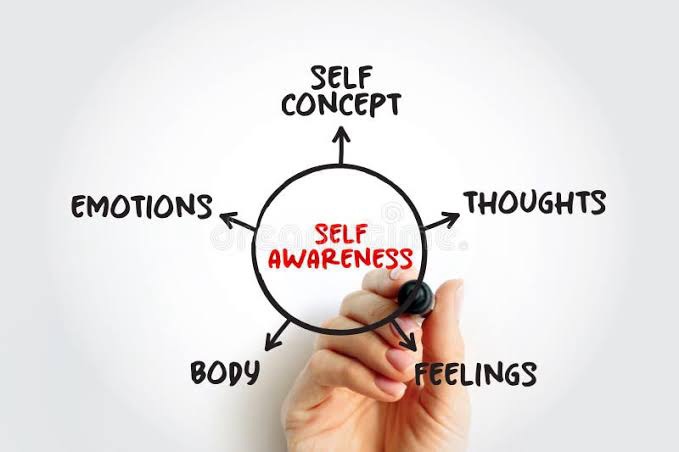
3. Self-awareness is a psychological skill of knowledge and understanding about one’s own emotional state. It’s about self-observation, self-assessment of one’s emotions, thoughts, feelings, reactions and actions. It’s a capability of recognising one’s own reactions, actions, and behaviour in interacting with the outside environment and other people. Self-awareness helps in identifying tendencies, understanding emotional states, strengths, weaknesses, limitations and personal goals. It’s a lifelong learning ability to develop confidence and optimism in this dynamic world.
4. Self-awareness can be beneficial in several ways:
• Helps in building self-esteem, self-control, creativity, and skills
• Benefits include self-acceptance, emotional growth, and self-development.
• Aids in decision-making.
• Understanding strengths, weaknesses, and limitations.
• Accurate self-reports.
5. For several decades, thousands of research studies have been carried out to understand the interconnectedness between self-awareness and important key attitudes of human behaviour like habits, feelings, emotions, happiness, stress parameters, empathy and job satisfaction. Broadly, two types of self-awareness studies are recorded as :
• Internal self-awareness: It’s the ability to observe and monitor our inner world, while some label it as a state of self-consciousness temporarily. It is found to be associated more with relationships and job satisfaction as we try to fit ourselves with our personal control and social control.
• External self-awareness: Some state it as the difference between how we see ourselves and how others perceive us. Studies show that people who understand how others see them can be more empathetic and understanding of others’ perspectives.

6. Extensive research has identified five layers of self-awareness:
• Physical: Awareness of your physical body as shape, size, gender, race, ethnicity and five senses.
• Energetic: The breath and energy levels, which include the life forces that help you to move, think, create and take action.
• Mental: The thoughts, feelings, emotions that help you to react and take actions for yourself, others and life.
• The Witness: When you learn to become your witness and become aware of the different layers of self-awareness without being judgmental. This is an essential part of the path of learning self- awareness because you can bring about changes, a better understanding of your flaws, unhelpful patterns of beliefs, and habits that need to change.
• Bliss: Deep connection with a Higher Self, the Truth. A spiritual interconnectedness with the Divine.

7. The skill of knowing yourself is the biggest deal. If we actively start employing this art of self- awareness, we see ourselves as in a mirror, no hidden veil, just inside out, the reality as it is. Then,we start to find acceptance within ourselves, develop resilience if changes are not possible, and consciously bring about changes in our reactions, habits, behaviour and actions in our day-to-day life whenever required. This makes our everyday life approach easier, better handling relationships with people around, self -efficacy in controlling our mind, emotions, impulses, feelings, reactions, dealing with the external environment, people and the world around as it is.

8. Being in a path of self-awareness asks us to understand:
• Clear knowledge of our basic nature, character, impulses, flaws and desires.
• Observe our own habits and behaviour in dealing with our inner world and external world.
• In alignment with our energy levels and breath, and how they are affected by our choices and lifestyle.
• Keep an eye on our thoughts, feelings, emotions, impulses and learn to respond rather than react to whatever life throws us.
• Being a witness to self (intuitive wisdom) so that self-acceptance is easier without being judgmental.
• Searching for our connectedness to something bigger than ourselves.

9. Practising and learning to seek self-awareness is far from being an easy task; it is a lifelong process. Our day-to-day life is so much attuned to working, earning money, parenting, paying the mortgage, bills, and routine hustles that we hardly get time for ourselves. Besides, many obstacles cause hindrance in this path :
• Fear – Knowing and understanding our vulnerability, uncomfortable emotions, and weaknesses.
• Attachment – attachment to people, desires, things can often lead to internal conflicts.
• Aversions – Conscious understanding and resurfacing of situations, people, we usually avoid, internal conflicts, unresolved emotions and discomforts.
• Ego- Instead of being the centre of the world around us, knowing that ego is that tool to distinguish us “I” from the outside world, learning to balance it with wisdom rather than controlling us.
• Ignorance – Learning and understanding about the larger picture of life, rather than being happy when life goes well and disliking it whenever life throws challenges.

10. Developing and seeking self-awareness is an ongoing process, a lifelong learning. In this process, as an individual, there is tremendous personal growth, control over emotions, decision- making and self-acceptance with limitations. Some of the basic strategies are:
• Daily practising mindfulness, calmness, and reflections upon thoughts without judgement.
• Journaling your thoughts, feelings, emotions, impulses on experiences and situations.
• Getting honest feedback from trusted friends, family members, siblings, and partners.
• Self-analysing the situations that can trigger strong emotional responses like anger, panic- attacks, pain, and fear.
• Self- assessment of limitations, weaknesses, strengths, and levels of resilience.
• Routinely reviewing the day-to-day reactions, actions, decisions and interactions.
Thanks for reading.
Peace and love 🙏
 3H:health,happiness,healing
Lol. Some leaders get it. Others are oblivious or to mistakingly believe that are self aware while being clueless.
LikeLiked by 2 people
Thanks for your genuine response!
LikeLiked by 1 person
It’s true—some leaders truly understand, while others either don’t see it at all or think they’re self-aware when they’re actually missing the mark entirely.
LikeLiked by 1 person
Thanks for your thoughtful response!
LikeLike
“Do not merely listen to the word [of The Bible], and so deceive yourselves. Do what it says. Anyone who listens to the word but does not do what it says is like someone who looks at his face in a mirror and, after looking at himself, goes away and immediately forgets what he looks like. But whoever looks intently into the perfect law that gives freedom, and continues in it—not forgetting what they have heard, but doing it—they will be blessed in what they do.” James 1:22-25
LikeLiked by 1 person
Thanks.
Great share !!
LikeLiked by 1 person
Great post. I am a big believer in self-care awareness and self care.
LikeLiked by 1 person
Thanks for your kind and thoughtful response.
LikeLiked by 1 person
You are very welcome.
LikeLiked by 1 person
A great reminder—true self-awareness means observing our thoughts, emotions, and actions, breaking autopilot habits, and taking control of our own growth.
LikeLiked by 1 person
Thanks for your kind response.
LikeLike
Grateful for your like! 💖 Subscribing to my channel would truly encourage me, and your feedback would guide me to improve. ✨
https://www.youtube.com/@safiabegum-h7m
LikeLiked by 1 person
Self awareness is really very important. Well shared 👌
LikeLiked by 1 person
Thanks for your kind response.
LikeLiked by 1 person
🙏
LikeLiked by 1 person
BUON WEEK-END
LikeLiked by 1 person
Thanks. Happy weekend to you too !
LikeLike
Well articulated post on self awareness. Eye-opening read.
LikeLiked by 1 person
Thank you so much for your thoughtful response 🙏
LikeLiked by 1 person
Very insightful post diving deep into the subject of self-awareness. Question: how do things like complicated grief or PTSD impact or influence our self-awareness?
LikeLiked by 1 person
Firstly, thank you so much for your thoughtful response. Appreciate it!
Yes, self-awareness is a great tool for people coping with PTSD or any traumatic experience.
Being a witness to your mind is important, understanding and recognizing the triggers, emotions without being negative, fearful or judgmental. Building up coping strategies to help calming the mind by taking therapy, mindfulness, meditation. It’s a slow process.
Professional help is essential.
LikeLiked by 1 person
Self awareness is important for all humans! The better we are at understanding ourselves the better and more fulfilling our lives can be! Thanks!
LikeLiked by 1 person
Thank you so much for your thoughtful response!
LikeLike
I really liked this post too! You have studied a lot in your life and have produced so much help and advice to help others. Tha k you, Sir.
LikeLiked by 1 person
Thanks a lot !
Really appreciate your kind feedback 🙏
LikeLiked by 1 person